
PCO Vehicle Requirements for London: A Complete Checklist
Getting your PCO vehicle requirements wrong in London can directly disrupt your earning potential.
It can mean a failed TfL inspection, a rejected PHV licence application, lost earnings while your car sits off the road — and in the worst cases, driving illegally without even realising it.
It is the absolute nightmare for most people exploring PCO vehicle hire for the first time.
Whether you are buying your own car, renting one, or exploring a PCO car rental, checking all the requirements for a PCO vehicle is necessary.
By the time you finish reading, you will know exactly
- What vehicle age and emission standards does TfL expects?
- What documents do you need and when?
- What happens step by step at a TfL PHV inspection?
- How to stay ready for a TfL spot check at any time?
Let's jump right in.
What Is a PCO Vehicle and Who Regulates It?
PCO vs PHV — what's the actual difference?
This is one of the most common misconceptions people hold while entering the industry. This is the simplest way to visualize it:
PCO licence = the driver. PHV licence = the vehicle.
The PCO licence — formally known as the Private Hire Driver Licence (PHDL) — is your personal permission from TfL to carry passengers for hire and reward.
The PHV licence is issued to the car itself. It confirms that a specific vehicle has been inspected, approved, and registered by TfL for private hire use.
Both must be in place simultaneously. One does not cover the other.
Who issues PCO vehicle licences in London?
London’s Private Hire Vehicle licences are only issued by Transport for London (TfL). No other authority, no shortcut, and no third-party service can issue one on TfL's behalf.
PCO Vehicle Requirements Checklist at a Glance
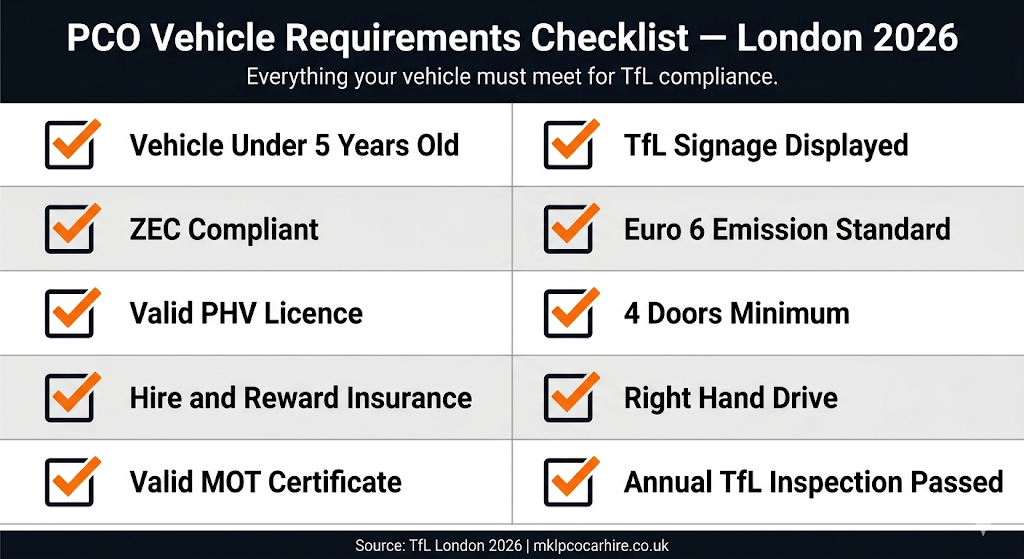
Vehicle Age Requirement — What TfL Actually Allows
New licence applications: the 5-year rule
This is where many drivers get caught out.
If you are applying with a brand new PHV Vehicle License, it basically means the car has never been licensed for a private hire before.
TfL specifically mentions that the vehicle should not be more than 5 years old in the first-time application.
Application and Renewal Criteria for Order vehicles
Older vehicles can be used only for renewals, not new applications.
Any vehicle with a current PHV licence will be able to be re-licensed until it is 10 years old. After 10 years, it is time to stop re-licensing under any route.
Emission Standards — ULEZ, Euro 6, and the ZEC Requirement
Euro 6 and Euro 4 Rule
Euro 6 and Euro 4 are EU-designated emission limits that show how much pollution a car engine releases.
For existing PHVs already licensed before 1 January 2023:
- Diesel vehicles must meet Euro 6
- Petrol vehicles must meet a minimum of Euro 4
The Zero Emission Capable (ZEC) rule for new vehicle licences
This is the requirement most drivers miss entirely — and it directly affects anyone buying or hiring a vehicle to register as a PHV for the first time.
From 1 January 2023, all PHVs licensed for the first time must be zero-emission capable and meet Euro 6. The vehicle should have either of two qualifications:
- Emit no more than 50g/km CO₂ and be capable of zero exhaust emissions for a minimum of 10 miles, or
- Emit no more than 75g/km CO₂ and be capable of zero exhaust emissions for a minimum of 20 miles
If the vehicle includes an internal combustion engine — such as a plug-in hybrid — it must also meet Euro 6 as a minimum.
If you are considering PCO vehicle hire rather than buying your own car, choosing a reputable PCO car hire like MKL means these emission standards are already handled — no compliance research needed before you hit the road.
Read our latest guide on “Electric vs Hybrid: Which PCO cars actually save you more in 2026.”
Physical Vehicle Requirements — Safety, Size, and Condition
Minimum doors and passenger capacity
It has to be able to fit 4 passengers without needing you to reach around your car (driver not included), and it has to have a minimum of 4 doors. Two-door/limited rear vehicles are not allowed.
All vehicles must be right-hand drive. Left-hand drive vehicles are not permitted unless a specific exemption is granted by TfL, which is only considered in exceptional cases.
Safety features TfL inspectors check
At a minimum, your vehicle must have all of the following in full working order:
- Functioning airbags (driver and passenger)
- ABS (Anti-lock Braking System)
- Working seatbelts on all seats
- Adequate tyre tread depth (minimum 1.6mm)
- No active dashboard warning lights
- Functioning brakes and suspension
Any defect in these areas will result in an immediate failure.
Cosmetic and mechanical condition standards
Vehicles need to be in good mechanical condition and appear tidy and presentable to TfL.
Visitors check if there appears to be any neglect, such as faded number plates, broken down bodywork, dirty interiors, or worn upholstery, which will mark against you.
The latest ng hs pco car and start your pco car rental pco car driving journey
Looking for a compliant, Uber-ready vehicle today? Browse MKL's latest PCO car hire fleet — hybrid, electric, and XL options all available.
Required Documents — Your Full Pre-Inspection Checklist
Documents to have before applying for a PHV vehicle licence
Before TfL will consider your vehicle for licensing, you need the following in place:
- Valid MOT certificate — required for vehicles over three years old
- V5C logbook (vehicle registration document) — confirms you are the registered keeper
- Proof of ownership or agreement — if obtained through rent-to-buy, provide the finance agreement
- Hire and reward insurance certificate — standard car insurance is not sufficient
- Manufacturer's Certificate of Conformity (CoC) — required if your V5C does not clearly confirm ZEC compliance or emission standards.
- Documents to keep in the vehicle at all times
Once licensed, these must be present in the vehicle whenever it is being used for private hire:
- PHV licence disc — must be displayed visibly (front and rear)
- Valid hire and reward insurance certificate
- Valid MOT certificate
- PHV driver badge — worn or available for inspection at all times
- What to bring on the day of your TfL vehicle inspection
Arrive at the TfL inspection centre with the following:
- Original MOT certificate
- V5C logbook or proof of ownership
- Valid hire and reward insurance documents
- Manufacturer's CoC (if ZEC verification is needed)
- Booking confirmation from TfL
Missing any of these on the day means a failed inspection and a rescheduled appointment — costing you both time and the rebooking fee.
This is our latest guide on “How to upload your PCO documents to the Uber app”.
The TfL PHV Vehicle Inspection — What to Expect on the Day
The TfL vehicle inspection is not something to wing on the day. It is a structured, methodical check, and arriving unprepared costs you time, money, and lost earnings.
Here is exactly what to expect.
Book Your Inspection
Visit the official portal of the TfL customer account(open 24 hours, 7 days a week). You can also call directly on 0343 222 5555. Select the date and time for your inspection. If necessary, you can reschedule it from your account.
If a retest is required after an inspection, there is a 21-day window to rebook for the retest.
What the Inspector Checks
The inspection covers every aspect of your vehicle's safety, condition, and compliance. Inspectors work through the following:
- Documents — MOT certificate, V5C, hire and reward insurance, and ZEC compliance evidence if applicable
- Exterior — bodywork condition, number plates, mirrors, lights, and doors
- Interior — cleanliness, upholstery condition, seatbelt function on all seats
- Safety systems — airbags, ABS, brakes, and suspension
- Tyres — minimum 1.6mm tread depth, correct pressure
- Dashboard — no active warning lights
- VIN verification — Vehicle Identification Number must match your registration documents
- Emission compliance — ULEZ and ZEC standards where applicable
- PHV licence disc display — must be correctly fitted front and rear
How Long It Takes and What It Costs
Normally, the inspection lasts for 45 minutes to one hour. The charge for this inspection is around £140, but it could be different; please refer to the TfL website for current inspection fee information before booking.
Common Reasons Vehicles Fail
Most failures are avoidable. The most frequent causes are:
- Active warning lights on the dashboard
- Worn tyres below the legal tread depth
- Non-functioning seatbelts or faulty brake lights
- Dirty or poorly presented interior
- Missing or incorrect documents on the day
- Modifications made without prior TfL approval
- VIN not matching registration documents
What Happens If Your Vehicle Fails
The inspector will provide you with written feedback on what needs to be improved. The required work can be done in 21 days, after which a retest is required. If you miss that window, you will need to submit a full new application — and pay the full fee again.
PHV Licence Plates and In-Vehicle Display Rules
This is one of the most overlooked areas of vehicle compliance — and getting it wrong is a criminal offence, not just an inspection failure.
Where the PHV Disc Must Be Displayed
Every licensed PHV must display two licence discs — one at the front of the vehicle and one at the rear. The disc consists of a central panel on a coloured surround, and both parts must be displayed together. Displaying only half of the disc does not satisfy the requirement.
The discs must not be:
- Removed, even when using the vehicle for personal journeys
- Damaged, altered, or tampered with in any way
- Concealed or obscured at any time
Failure to display a valid disc is a criminal offence, punishable by a fine of up to Level 2 on the standard scale.
A rear disc exemption can be applied for only if the vehicle has no rear window — for example, certain specialist vehicles. Applications go to TPHVehicleExemptions@tfl.gov.uk.
TfL Spot Checks — Always Be Ready
A TfL Authorised Officer or police constable can stop and inspect your vehicle at any time, without warning. There is no notice period. There is no scheduled appointment. It can happen anywhere, on any shift.
What TfL Officers Look for During a Spot Check
Officers carry out a swift but thorough check of both the vehicle and its documentation. They are looking for:
- PHV licence discs — correctly displayed front and rear
- Correct TfL signage — fitted and undamaged
- Valid hire and reward insurance — in force at the time of the check
- Valid MOT certificate — current and not expired
- Driver badge — worn or immediately available
- Vehicle roadworthiness — tyres, lights, brakes, and general condition
- Passenger capacity — not exceeding the licensed limit
If an officer is not satisfied with the vehicle's condition, they can serve an unfit notice on the spot — prohibiting use of the vehicle entirely until the defect is resolved. That means no driving, no earning, until it is fixed.
Documents You Must Produce Within 7 Days if Requested
Not every document needs to be in the vehicle at all times. However, if an officer requests the following, you are legally required to produce the originals within 7 days:
- PHV vehicle licence
- Valid MOT certificate
- Hire and reward insurance certificate
- V5C vehicle registration document
Failing to produce these within the 7-day window is a breach of your licensing conditions and can trigger further action from TfL.
Ready to Get on the Road?
Getting PCO vehicle compliance right takes time — managing MOT dates, PHV renewals, insurance, and inspections alongside a full driving schedule is a real burden.
With MKL PCO Car Hire, it is already handled. Every vehicle comes with insurance, MOT, PHV licence, and servicing bundled into one simple weekly payment.
Hybrid, electric options available — all TfL-licensed and Uber-ready car hire.
Browse our vehicles or get in touch today.
Frequently Asked Questions About PCO Vehicle Requirements
Does a PCO car need to be ZEC in 2026?
Yes – if it has not had any PHV licence before, it must be Zero Emission Capable. This rule has been effective since 1st January 2023 and will be active in 2026.
How old can a PCO car be in London?
New PHV license applications car may not be more than 5 years old. Previously licensed vehicles may be re-licensed until they are 10 years old, but no further than that, per the normal route.
What insurance do I need for a PCO vehicle?
You must have hire and reward insurance. Standard personal car insurance is not valid for private hire use, and TfL will not issue or renew a PHV licence without it.
How often does a PCO vehicle need to be inspected?
Every year. A PHV car licence, which is valid for 12 months, necessitates a TfL inspection with each renewal. In addition, all vehicles more than 12 months old must have a current MOT certificate as well as an annual licensing inspection.
Related Posts
More miles, more passengers, more stop-start traffic through central London — a PCO vehicle works harder in a single week than mos

Thinking about driving PCO Car Hire in London? Before you sign up for a PCO car, it helps to know exactly where
Leave a Reply