TfL Vehicle Inspection for PCO Cars: How to Book and What’s Checked
A PCO car driver needs a Private Hire Vehicle(PHV) licence from Transport for London to make money on Uber and Bolt in London.
In order to be eligible to receive one, the car will have to be subject to a vehicle inspection by TfL. Without the right documentation and/or an unprepared vehicle, you may lose days of work.
Today we will explain how to participate in the booking, what to bring, what the inspectors will be looking at, preparing for the inspection, and what you can do if the car fails the inspection.
What Is a TfL Vehicle Inspection?
A TfL vehicle inspection is the check a car must pass before TfL will licence it as a private hire vehicle. It is separate from your PCO driver licence, which covers you as a person. The vehicle licence covers the car.
For vehicle licences, TfL states that they will last for 12 months from the inspection date, so this will need to be repeated annually.
Make a well-timed renewal before the end of the term. Inspection slots can run out, and a gap in your licence means a gap in your earnings.
How to Book a TfL Vehicle Inspection
TfL lets you book online at any time, or by phone on 0343 222 5555 (call charges may apply). Always start from TfL’s private hire vehicle licence page, not a third-party booking site.
- Check that the car qualifies first. Confirm the age and emissions rules below before you pay for anything.
- Gather your original documents. See the next section.
- Book through TfL. Use the online booking route on TfL’s PHV licence page, or call.
- Note your appointment details. Keep the confirmation with your documents.
- Arrive prepared. Check the car over beforehand, using the checklist later in this guide.
TfL states that the application fee is £84 and non-refundable, with a separate grant of licence fee. Confirm current amounts on TfL’s page before you book.
Age and emissions rules to check before booking
TfL’s published criteria say vehicles already licensed must be no older than 10 years at the time of licensing. From 1 January 2023, all PHVs issued for the first time will be zero-emission capable and Euro 6 compliant.
This means that a car capable of zero emissions (ZEC), which includes fully electric cars or a qualifying plug-in hybrid car, must not be licensed as a PHV.
TfL’s published ZEC definition has included a CO2 limit and a minimum zero-exhaust-emission range, so check the exact criteria for your model.
TfL has also opened a consultation, running until 2 December 2026, on requiring all newly licensed private hire vehicles to be zero-emission. That is a proposal.
It is not a current rule, but it is worth watching if you’re choosing a car for the next few years.
Need a TfL-approved vehicle licence PCO car that’s ready for private hire work? View available PCO cars at MKL Cars.
Documents Required for a TfL Vehicle Inspection
TfL asks you to bring originals. According to its PHV licence page, the list includes:
- Your existing TfL vehicle licence and discs, if you’re renewing
- The V5C registration certificate
- Hire and reward insurance documents
- An MOT certificate issued within the last 14 days tfl
- Vehicle modification documents, where they apply
Some cars need extra paperwork. A manufacturer's certificate of conformity (CoC) is required at the inspection for ZEC checks, TfL has indicated. Conditions may vary according to the type of application – refer to the list before travelling.
If you are hiring your car, enquire from the car hire company what kinds of documents they provide and what you need to bring yourself.
What Is Checked During a PCO Vehicle Inspection?
TfL does not always provide an inspection checklist item by item, and inspection is not always the same.
The following is a discussion of items that drivers can expect to be checked, as typical roadworthiness and licensing procedures go.
Safety and roadworthiness
- Brakes and warning lights
- Tyres, including tread depth and condition
- Steering and suspension
- Lights and indicators
- Windscreen, mirrors and visibility
- Seat belts
- Bodywork and general condition
Licensing-specific points
- Whether the vehicle meets TfL’s age and emissions criteria
- Registration and vehicle details matching your documents
- Four doors and suitable passenger space
- Licence discs, which TfL requires PHVs to display. It can grant exemptions from displaying discs in limited circumstances.
Right-hand drive. TfL’s page says PHVs must be right-hand drive unless an exemption applies.
Treat the first list as the minimum standard a decent car should meet anyway, and the second as the checks that decide whether TfL will license it.
TfL Vehicle Inspection vs MOT: What’s the Difference?
An MOT is the national annual roadworthiness test. A TfL inspection is a licensing check for private hire use. Passing one does not mean you pass the other.
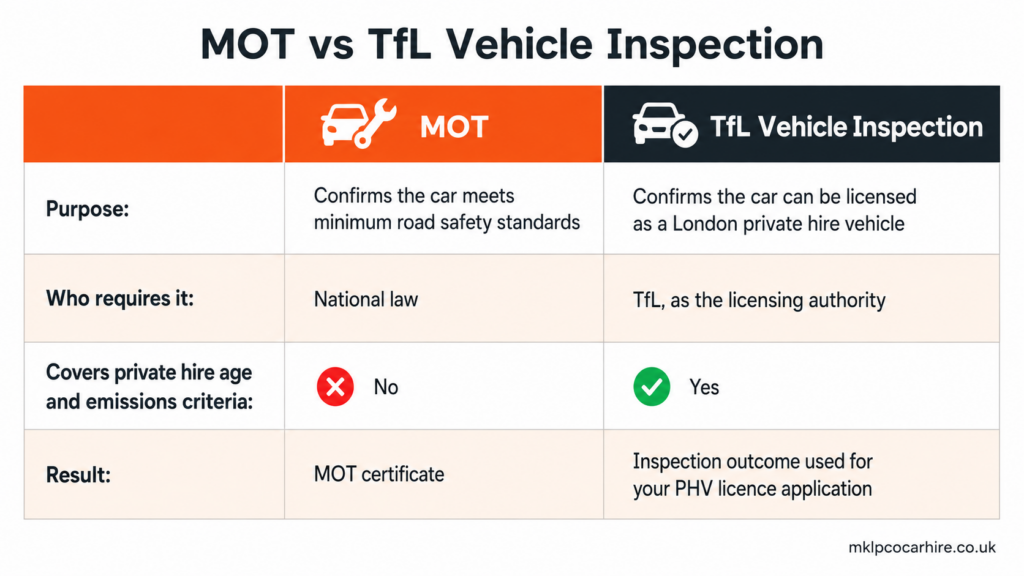
You need both. As TfL’s list shows, a recent MOT is one of the documents you bring to the inspection, so the two work together.
How to Prepare Your PCO Car Before the Inspection
Most avoidable failures come down to things you could have checked in your driveway. Run through this before your appointment.
- Tyres: Inspections must be made on the tires, including tread, sidewalls, and tire pressure (including the spare tire).
- Lights: Lights must be checked for both the front headlights and rear brake lights, indicators, fog lights, and license plate lights. Another person must operate the brake pedal as you check the rear lights.
- Dashboard: Start the engine and look for warning lights. Sort any before the appointment.
- Windscreen and mirrors: Look for cracks and chips in the driver's vision and windshield washer fluid.
- Seat belts and doors: Belts must all be stretched to confirm they are functioning; doors and windows must all be operated several times to confirm they work correctly.
- Check fluids and leaks: Check the oil, coolant, and brake fluids and make sure there are no new leaks under the vehicle.
- Cleanliness: inside and out. A neat vehicle presents a better appearance and is easier to check.
- Paperwork: The documents must be put in the order according to TfL document requirements within the 14 days of MOT expiry.
What Happens If Your PCO Car Fails the TfL Inspection?
Failure at the inspection does not guarantee that the car will not be licensed the next time. The most common safety defects that cars lack are basic safety features, emissions or age eligibility, and missing paperwork.
TfL’s public pages don’t set out every re-inspection rule, so don’t rely on guesswork. The sensible steps are:
- Read the inspection report carefully and note exactly what was flagged.
- Fix the defects, keeping receipts and any repair evidence.
- Check TfL’s guidance, or contact TfL, to confirm whether you need a new booking and whether another fee applies.
- Book again only when the car genuinely meets the criteria.
Remember that TfL will not inspect or license a vehicle unless it meets their requirements, and owners will ask TfL to inspect the vehicle at their own risk and at their own cost.
Repairs won't help if the failure has to do with eligibility (such as age or emissions).
Frequently Asked Questions
How often does a PCO car need a TfL inspection?
The vehicles are licensed by TfL and will be valid for 12 months from the date of the inspection, so be prepared for an inspection every year.
Can I use my car for Uber after passing an MOT?
No. The car also needs a TfL PHV licence, and you need your own PCO driver licence. Uber also has its own requirements, so check its current guidance.
H3: Can I book a TfL vehicle inspection myself?
Yes. TfL allows online booking and phone booking, as above.
Do all PCO vehicles need to pass a TfL inspection?
A vehicle needs to be inspected to be licensed as a London PHV. Some cases involve exemptions, but they are decided by TfL.
What should I check before taking my car in?
Tyres, lights, warning lights, mirrors, seat belts, doors, fluids, and your documents. Utilise the checklist above.
Can I hire a car that is already prepared for PCO licensing?
Yes. A lot of motorists book a vehicle from a PCO provider which is configured for private hire. Enquire with the provider about the documents and licensing requirements for vehicles; this varies by arrangement.
Get Your PCO Car Ready for the Road
A TfL inspection is easier when you know the booking route, bring the right originals, and check the car yourself first.
If you’d rather not source and prepare a car on your own, MKL Cars offers PCO car hire and rent-to-buy options for London private hire drivers. Check current vehicles and terms with the team before you commit.
Related Posts

How Much Does PCO Car Hire Cost in London? [2026 Breakdown]
Many drivers see a weekly price onl

Best Cars for PCO Car Hire in 2026: The Complete Guide for UK Private Hire Drivers
Fuel prices