
PCO Car Maintenance Checklist: How to Keep Your Uber Vehicle on the Road
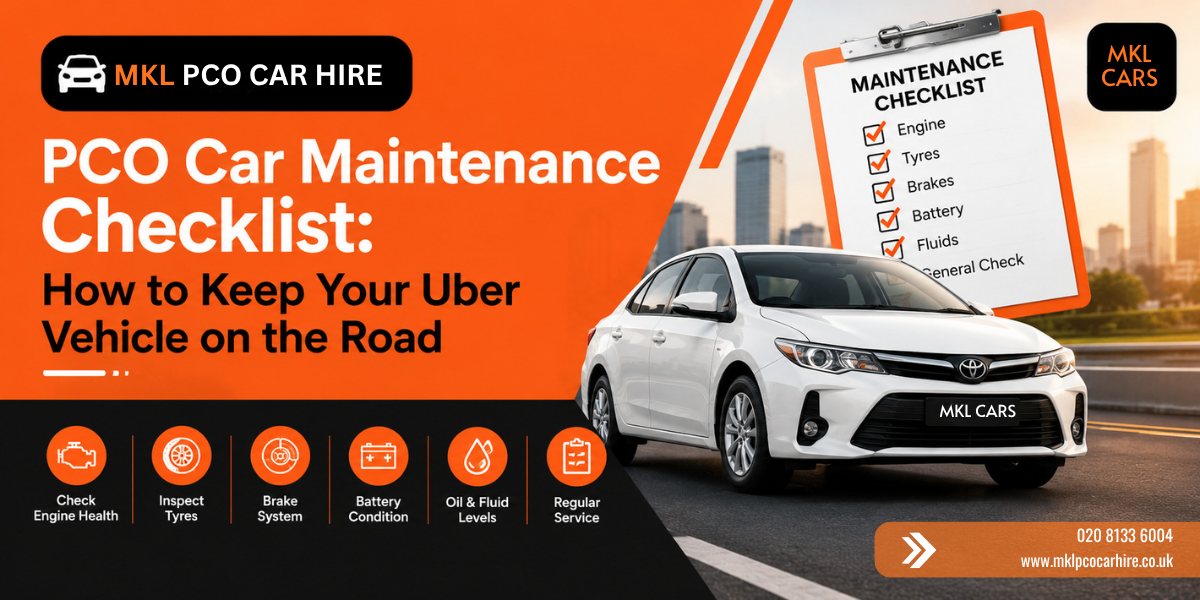
More miles, more passengers, more stop-start traffic through central London — a PCO vehicle works harder in a single week than most private cars do in a month.
That extra strain doesn't always show up straight away. It shows up later, usually at the worst possible moment: a dead battery on a Friday night, a slow puncture before an airport run, a warning light that finally can't be ignored.
For drivers earning through Uber or another private hire operator, a car off the road isn't just an inconvenience. It's lost income.
A simple maintenance routine, built around a few honest checks done regularly, is one of the cheapest ways to protect both your safety and your weekly earnings.
Why Vehicle Maintenance Matters for PCO Drivers
A private hire vehicle doesn't lead an easy life. All the hours of driving in London traffic, long hours of driving, constantly braking and accelerating through traffic, add up to wear that a typical commuter car will never experience.
For PCO work, the need for maintenance is more important than in regular driving for a few reasons:
- High mileage, faster wear. Many PCO drivers cover in a week what an average driver covers in a month, which shortens the life of tyres, brakes and consumables.
- Stop-start driving. Constant braking in traffic accelerates brake and tyre wear more than steady motorway miles do.
- Passenger safety. You're not just responsible for yourself. A fault that would be a minor annoyance in a private car becomes a safety issue with a passenger on board.
- Reliability and earning time. Every hour spent at a garage, or worse, stranded on the roadside, is an hour you're not earning.
- Passenger experience. Ratings and repeat bookings are shaped by how the car looks, smells, and drives — not just how it performs mechanically.
None of this means you need to become a mechanic. It means building small checks into your routine so you catch problems early, while they're still cheap and quick to fix.
Daily PCO Car Maintenance Checklist
A five-minute look-over before you go online catches most of the issues that would otherwise cost you a shift.
- Tyres — a quick visual check for cuts, bulges or anything embedded in the tread. A tyre that looks low is worth checking with a gauge before you set off.
- Lights — headlights, brake lights and indicators. A blown bulb is an easy fix but an easy way to fail a spot check.
- Windscreen and wipers — clear glass and a full washer reservoir matter more than they seem, especially in rain or low light.
- Mirrors — clean and correctly adjusted before your first pickup.
- Warning lights — glance at the dashboard on start-up. Anything new deserves attention, not a shrug.
- Leaks — a look underneath the car for anything pooling on the ground overnight.
- Fuel or charge level — enough to comfortably get through your first few jobs without route anxiety.
- Interior check — a passenger-ready cabin: no clutter, no rubbish from the last shift, no lingering smells.
None of this replaces a proper inspection, but it takes the guesswork out of whether your car is fit to start the day.
Weekly PCO Vehicle Maintenance Checklist
Once a week, go a little deeper than the daily glance.
- Tyre pressure — checked properly against the figures in your vehicle handbook, ideally when the tyres are cold.
- Tyre tread — the legal minimum in the UK is 1.6mm across the central three-quarters of the tyre, measured around its full circumference. Many manufacturers and safety bodies recommend replacing well before that point, since stopping distances lengthen noticeably as tread wears down.
- Fluid levels — engine oil (where applicable), coolant, and screenwash. Never remove a coolant cap when the engine is hot.
- Wipers — replace if they're streaking or juddering.
- Brakes and steering — any pulling to one side, vibration through the wheel, or new squealing or grinding is worth booking in for a look.
- Exterior and interior condition — a proper clean, inside and out, does more for passenger impressions than most drivers give it credit for.
Some of this you can genuinely assess yourself in a car park in ten minutes. Anything involving brake components, suspension or unusual noises is better left to someone with a ramp and the right tools.
Monthly PCO Car Maintenance Checklist
A monthly once-over is where slower-developing problems tend to surface.
- Battery health — short trips and constant stop-start driving put real strain on a 12V battery. Struggling to start or electronics behaving oddly are both signs worth having tested.
- Air conditioning and heating — check they're working properly before the weather forces the issue.
- Cabin filter — persistent musty smells or windows that mist up quickly can point to a filter that needs changing.
- Suspension symptoms — any new knocking or wallowing over bumps.
- Warning lights, again — anything intermittent that didn't show up daily might reappear here.
- Service schedule — check where you stand against your manufacturer's recommended intervals, not just the calendar.
- General inspection — a broader look for anything that's crept up gradually rather than appeared overnight.
Read our detailed guide on The True Cost of Being a PCO Driver in London: A Complete 2026 Breakdown
PCO Car Servicing: When Should You Book It?
Servicing intervals are individual to each PCO car, and vary by manufacturer, model, fuel type, and even per vehicle age in some instances. Your vehicle's manual or the manufacturer's advice is the only sure thing.
What is consistent across most vehicles:
- High-mileage PCO use often means you reach a manufacturer's mileage-based service point well before the time-based one, so it's worth tracking the odometer rather than assuming a service is a once-a-year event.
- Ignoring a service reminder light doesn't make the underlying issue go away — it just delays when you find out about it, usually somewhere less convenient.
- Keeping service records matters, both for resale value and because some private hire inspections or insurance claims may ask for evidence of upkeep.
- If something feels different — a new noise, a change in how the car pulls or brakes — that's worth a professional look regardless of where you are in the service cycle.
MOT and PCO Vehicle Checks
This is a very common mistake made by new drivers, as it might seem like the same thing, but it isn't.
- In the UK, most vehicles must undergo the annual road safety test (MOT), which covers things like brakes, tyres, lights, emissions, and structural integrity, among other areas.
- The vehicle licence inspection will be organised by Transport for London in London and one of the papers you will be required to produce is a valid MOT certificate within 14 days of the inspection. If you're licensed outside London, requirements and frequency of inspection may vary, so be sure to check with your licensing authority or directly with TfL for the rules currently in effect for your vehicle and region.
The passing of an MOT doesn't necessarily imply that a vehicle fulfils all private hire requirements; the checks are based on the same criteria but not the same.
However, if you are not certain as to what applies to your particular vehicle, then the answer is to check TfL's own guidance (or your local council's if you are licensed outside London – not a forum post or another driver's recollection of what the rules say).
Warning Signs You Should Never Ignore
Some issues are safe to monitor for a few days. Others mean you should stop driving and get the car looked at before your next shift, not after it.
- Dashboard warning lights — particularly anything related to brakes, engine temperature, or airbags.
- Unusual brake noises — grinding or persistent squealing usually means worn pads or discs.
- Steering problems — vibration at speed, or the car pulling to one side.
- Vibrations generally — often tyre balance, tyre damage, or a suspension component.
- Unusual engine noises — knocking, tapping, or anything that wasn't there last week.
- Fluid leaks — anything pooling under the car overnight.
- Loss of power — sudden or gradual, both are worth investigating.
- Tyre damage — bulges, deep cuts, or exposed cord are not something to drive on.
- Overheating — stop safely, let the engine cool, and get help rather than continuing.
- Reduced EV range — a sudden, unexplained drop can sometimes point to a fault rather than just cold weather or driving style.
If in doubt, treat it as a reason to stop rather than a reason to push on for one more job.
Can PCO Car Hire Make Vehicle Maintenance Easier?
For a lot of drivers, the appeal of hiring a PCO vehicle rather than running their own isn't just about avoiding a deposit — it's about not having to manage servicing, MOT renewals, insurance and breakdown cover as separate, ongoing admin tasks on top of driving.
This is where a professionally managed hire arrangement can genuinely take some of the maintenance burden off a driver's plate, provided the details of what's included are clear from the outset.
MKL PCO Car Hire, for example, bundles insurance, breakdown cover, servicing, PCO compliance and MOTs into a single weekly package, alongside a dedicated customer support team and an accident management service that works with a network of trusted garages to keep repair-related downtime to a minimum.
We offer a mix of hybrid, fully electric and XL vehicles, along with a rent-to-buy option for drivers who'd rather work towards ownership than hire indefinitely.
Check top Uber-ready cars for drivers in london.
PCO Car Maintenance Checklist — Quick Reference
| Check | How Often | What to Look For |
| Tyres | Daily glance / weekly proper check | Pressure, damage, tread depth (1.6mm legal minimum) |
| Lights | Daily | Blown bulbs, dim or cracked lenses |
| Fluids | Weekly/monthly | Oil, coolant and screenwash at correct levels |
| Brakes | Ongoing, more closely weekly | Noise, vibration, pulling, poor response |
| Windscreen and wipers | Daily | Chips, cracks, streaking wipers |
| Warning lights | Daily | Any new dashboard alert |
| Battery (12V) | Monthly | Slow starts, flickering electronics |
| Servicing | Per manufacturer schedule | Mileage or time-based service due |
| MOT | Annually (age-dependent) | Valid certificate, in date |
| PCO/TfL licensing inspection | As required by your licensing authority | Current compliance, valid MOT within required window |
Frequencies here are general good practice rather than fixed rules — always check your vehicle handbook and current TfL or local council requirements for anything specific to your car and licensing area.
Final Thoughts
Maintaining a PCO car is not a difficult thing to do, however, it does require consistency. With a single daily look, a good weekly review and a monthly once over, most of the issues that would be a lost shift and/or repair cost can be caught.
If the admin side of ownership — servicing, MOT renewals, insurance, breakdown cover — is starting to feel like a second job on top of driving, it's worth looking at whether a managed PCO car hire package would suit you better than running your own vehicle. Get in touch with MKL PCO Car Hire to talk through the options.
FAQs
How often should a PCO car be serviced?
There isn't a fixed number for every car, but it will typically be one of the two: mileage or time, whichever is reached first. Many drivers are doing so much driving each year that the mileage may be surpassed well before the time limit, so read the handbook and monitor the mileage on the odometer, instead of assuming that annual service is sufficient.
What should an Uber driver check before starting work?
Checking tyres, lights, windscreen and washer fluid, warning lights on the dashboard, and checking for obvious leaks takes a few minutes each day and is effective in noticing most problems before they cause a problem mid-shift.
What maintenance does a PCO car need that a normal car might not?
The same fundamentals apply — tyres, brakes, fluids, servicing — but PCO cars typically need them checked more often because of higher mileage and more stop-start driving.
Related Posts

Thinking about driving PCO Car Hire in London? Before you sign up for a PCO car, it helps to know exactly where

Uber Car Hire Requirements UK: The Complete 2026 Guide
Considering driving an Uber but not cert
Leave a Reply